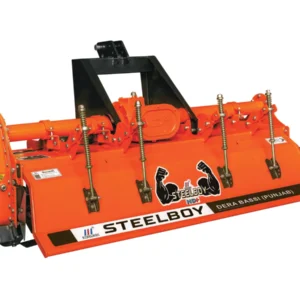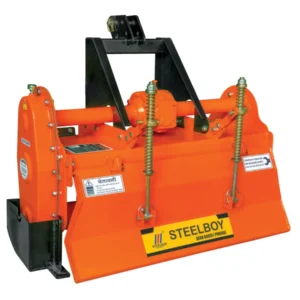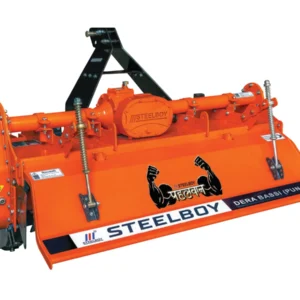
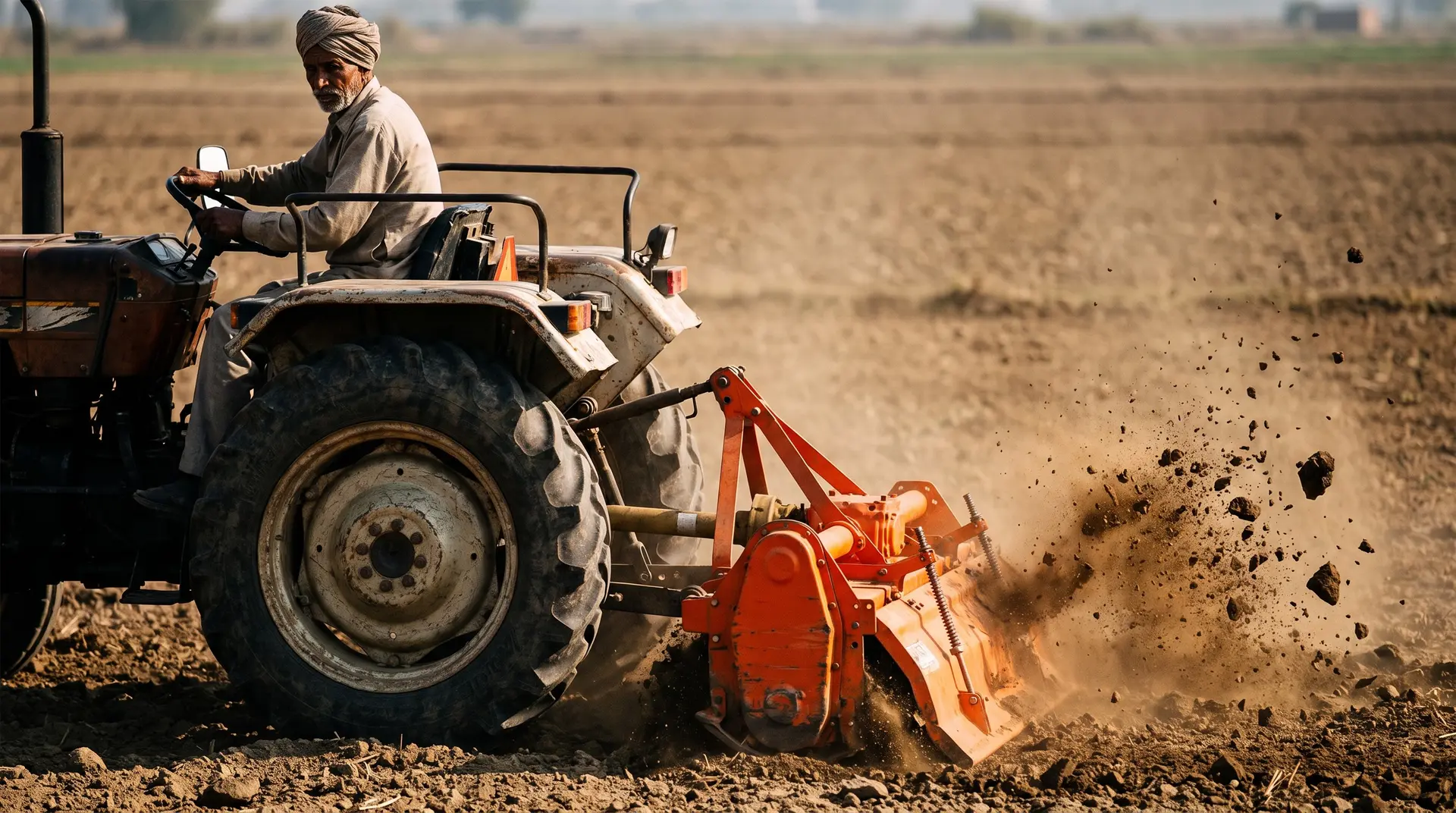
Few implements have changed field preparation in India as much as the rotavator. Where farmers once needed several passes with a plough and cultivator, a rotavator can often prepare a fine, level seedbed in one or two passes. In this guide we explain what a rotavator does, the practical benefits, how it compares with other tillage tools, and how to choose the right size for your tractor.
What does a rotavator do?
A rotavator (also called a rotary tiller) is a tractor-mounted implement driven by the tractor’s PTO shaft. Inside the body, a horizontal rotor carries L- or C-shaped blades. As the rotor spins, the blades cut into the soil, break clods and mix the soil with crop residue. A trailing board at the back levels the surface. The result is loose, crumbly soil — a good bed for seeds and young roots.
Because the blades are driven by the engine rather than simply pulled through the soil, a rotavator does more work per pass than a drawn implement. The gearbox and side gear transfer power from the PTO to the rotor; on Steelboy rotavators the side gear drive is 20:35:28 and the gearbox is either single-speed (Mini Series) or multi-speed (HD, HD Plus, Zyro and Pahalwan).
8 benefits of using a rotavator
1. Fine tilth in one pass
The rotating blades break clods and pulverise the topsoil far more than a cultivator. In many fields one or two passes are enough to get a seedbed ready for sowing.
2. Saves time
Fewer passes means less time on the tractor. That matters most in tight windows — for example between paddy harvest and wheat sowing — when a few days can affect yield.
3. Saves diesel
Replacing multiple passes with a plough, harrow and cultivator by one or two rotavator passes generally reduces total fuel used for field preparation, as well as wear on the tractor.
4. Mixes crop residue into the soil
The blades chop and mix stubble and residue into the topsoil, where it breaks down and adds organic matter instead of being burnt.
5. Better germination
A fine, even seedbed gives seeds good soil contact and uniform moisture, which helps them germinate evenly.
6. Weed control
Rotavating uproots and buries small weeds before sowing, reducing early weed pressure on the crop.
7. Works in dry land and wet land
The same machine prepares dry fields for wheat and puddles wet paddy fields. Paddy-special models such as the Pahalwan Rotavator are built for wet, sticky soil with a powder-coated body that resists water and mud.
8. Level surface
The spring-loaded trailing board smooths the soil behind the rotor, leaving a more level field that is easier to irrigate and sow.
Rotavator vs cultivator vs plough
| Implement | What it does | Best for |
|---|---|---|
| Rotavator | Powered blades cut, pulverise and mix the topsoil | Final seedbed preparation, residue mixing, paddy puddling |
| Cultivator | Rigid or spring tynes loosen and stir the soil | Secondary tillage, weeding between crops |
| Plough (mouldboard / reversible) | Turns over and inverts the soil | Primary tillage, burying weeds and residue |
| Chisel plough | Heavy tynes break hard-pan without inverting | Deep tillage, drainage and root growth |
These tools work together. Many farmers deep-till with a chisel plough or reversible plough every few seasons, and use a rotavator for regular seedbed preparation. Read our guide on chisel plough vs mouldboard plough for more on deep tillage.
Choosing the right size by tractor HP
A rotavator that is too wide for your tractor will load the engine and slow you down; one that is too narrow wastes your tractor’s capacity. Use this as a starting point, then check the exact model table for your choice:
| Tractor HP | Suggested size | Steelboy range |
|---|---|---|
| 12–30 HP | 2.5–4 ft | Mini Series Rotavator |
| 35–45 HP | 5–6 ft | HD, HD Plus, Zyro, Pahalwan |
| 45–65 HP | 7–9 ft | HD and HD Plus (SR748 to SR960), Zyro SR760 |
Soil also matters. Heavy, dry or stony soils need a stronger machine — that is where the extra-heavy-duty HD Plus Rotavator helps. For orchards and vegetable plots, the compact Mini Series fits between rows and works with small tractors.
Blades and gearbox: what to look for
L-type and C-type blades
Most rotavators use L/C blades. L-shaped blades cut cleanly through soil and residue and suit dry and mixed conditions; C-shaped blades curve more and are popular for wet paddy work. Blade count also matters: more blades on the same width give a finer tilth per pass. That is why the new Zyro Series Rotary Tiller carries 48 to 60 blades on 5.5 to 7 ft.
Blade material decides how long the blades last in abrasive soil. Boron steel blades are heat-treated for hardness and wear resistance, so they keep their shape for longer than ordinary steel.
Single-speed or multi-speed gearbox
A single-speed gearbox is simple and suits small tractors and light work, as on the Mini Series. A multi-speed gearbox lets you change the rotor speed to match the soil: a higher speed for a finer tilth in light soil, a lower speed for heavy or wet soil where you need more torque. For most farms using 35 HP and above, a multi-speed gearbox gives more flexibility across seasons.
Common mistakes to avoid
- Working in very wet soil (for dry-land crops): the blades smear the soil and create a hard layer below. Wait until the soil crumbles in your hand.
- Too many passes: over-tilling turns soil into fine dust that crusts after rain. Stop when the seedbed is ready.
- Driving too fast: a high forward speed leaves clods. Keep a steady, moderate speed.
- Ignoring depth: set the side skids for an even working depth across the width.
- Wrong PTO speed: run the PTO at the speed recommended for the implement to avoid overloading the gearbox.
Maintenance tips
- Gear oil: check the gearbox and side-gear oil level before the season and top up as recommended. Change the oil at the intervals in your operator’s manual.
- Blades: inspect blades daily during heavy use. Replace worn or bent blades in sets and tighten blade bolts.
- Greasing: grease the bearings and PTO shaft joints regularly.
- Oil seals: watch for leaks around the seals. Steelboy rotavators use dual cone mechanical oil seals to keep mud and water out.
- After use: clean off mud — especially after paddy work — and store under cover.
Frequently asked questions
How many passes does a rotavator need?
In most fields one or two passes are enough for a sowing-ready seedbed. Very hard or dry soil may need a deep tillage pass first.
Can a rotavator be used in paddy fields?
Yes. Rotavators are widely used for puddling wet paddy fields. Paddy-special models like the Pahalwan are built to resist water and mud.
What size rotavator suits a 45 HP tractor?
Typically a 6 ft model. Check the tractor HP column in the model table — for example the Steelboy SR642 and SR648 are rated for 40–45 HP.
Choosing a rotavator?
Tell us your tractor HP and soil type — we will suggest the right Steelboy model.