
Look closely at almost any field and you will find small highs and lows. They seem minor, but when you irrigate they decide where water goes. Low spots flood while high spots stay dry; seed and fertilizer perform unevenly; weeds take hold. Laser land levelling solves this by grading the whole field to a precise, even surface.
Why uneven fields waste water and fertilizer
In flood or furrow irrigation, water must reach the highest point of the field before the whole field is wet. That means low areas receive far more water than they need, and often stay waterlogged. The results are familiar to every farmer:
- More water and longer pump hours to irrigate the same field
- Uneven germination — seeds rot in low spots and dry out on high spots
- Fertilizer washes into low areas, so the crop gets uneven nutrition
- Weeds grow in patches where the crop is weak
How a laser land leveller works
A laser leveller system has four main parts working together:
1. Transmitter
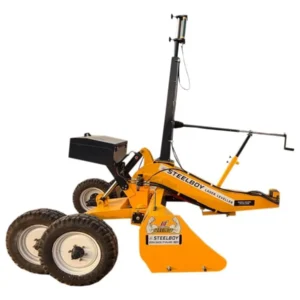
A rotary laser transmitter on a tripod at the field edge sends a rotating laser beam that creates a reference plane over the field. The Steelboy Laser Land Leveller works with the USA-made Alpha XD transmitter, which has an operating range of 1300 m diameter and supports single and double slope.
2. Receiver
A receiver mounted on a mast on the leveller bucket detects the laser beam and measures the bucket’s height relative to the reference plane.
3. Control box
The control box in the tractor cabin reads the receiver signal and automatically operates the hydraulic valve, raising or lowering the bucket many times per second.
4. Hydraulic bucket
The bucket scrapes soil from high spots and carries it to low spots. Steelboy’s leveller has a hydraulic extend system, a high-quality hydraulic jack and four heavy-duty wheels.
Benefits of laser levelling
- Saves irrigation water up to 20–25%: water spreads evenly across the field, so less is needed to irrigate it.
- Uniform germination: even moisture across the field helps seeds germinate together.
- Fewer weeds: no waterlogged or dry patches where weeds take over.
- Higher yield and grain quality: uniform water and nutrition across the field increase productivity and farm income.
- Saves electricity and diesel: shorter pump hours mean lower irrigation running costs.
- Saves labour: irrigation is quicker and easier to manage.
Signs your field needs levelling
- Water takes much longer to reach one end of the field than the other.
- Some patches stay waterlogged for days after irrigation while others dry out quickly.
- The crop grows unevenly — yellow or stunted in low spots, thin on high spots.
- Weeds appear in the same patches every season.
- You need to run the pump much longer than neighbours with similar fields.
Laser levelling step by step
- Prepare the field: plough or cultivate so the soil is loose enough to move.
- Set up the transmitter: place it on a tripod at a stable point where the beam covers the whole field.
- Survey: drive across the field in a grid to record heights and find the average level.
- Set the target: choose a flat level or a gentle slope in the direction water should flow.
- Level: the control box raises and lowers the bucket automatically as the tractor moves soil from high to low areas.
- Check: do a final survey pass to confirm the field is within the target.
Own or hire?
A laser leveller is a significant investment, and one machine can level many farms in a season. Many farmers hire levelling as a service, while tractor owners and custom hiring centres buy a leveller to offer that service in their area. If you plan to offer levelling to other farmers, the extend system on the Steelboy leveller lets you match the bucket width to different fields and tractors.
When to level your field
The best time is before the main season — before kharif sowing or before rabi sowing — when the field is empty and the soil is dry enough to move. Levelling a wet field is slow and leaves ruts. Once a field is laser-levelled, it usually only needs a light touch-up every few years, depending on how it is ploughed and irrigated.
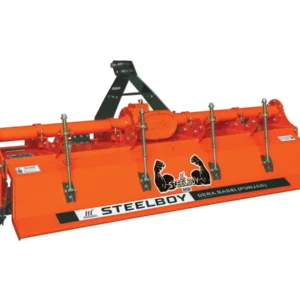
Before levelling, plough or cultivate the field so the bucket can move loose soil. After levelling, prepare the seedbed with a rotavator — see our guide on the benefits of using a rotavator.
Tractor and operator tips
- Use a tractor with enough power and a healthy hydraulic system — the bucket moves a lot of soil.
- Set up the transmitter on firm ground where the beam can reach the whole field without obstruction.
- Do a survey pass first to find the average height of the field, then set the target level.
- Work in overlapping passes and keep a steady speed.
- Protect the receiver and control box from water and dust, and keep batteries charged.
| Leveller bucket | Value |
|---|---|
| Working width | 7, 8, 9 ft |
| Extend system | 7→9 · 8→10 · 9→11 · 10→12 ft |
| Bucket height / width | 645 mm / 2134 mm |
| Weight | 800 kg (approx) |
Frequently asked questions
How much water can laser levelling save?
Levelled fields typically need less irrigation water. Steelboy’s brochure states savings of up to 20–25%; actual results depend on soil, crop and irrigation method.
How often should a field be laser levelled?
After the first levelling, a light touch-up every few years is usually enough, depending on tillage and irrigation.
Can the leveller bucket width be changed?
Yes. The Steelboy leveller has a hydraulic extend system, for example 7 ft to 9 ft or 10 ft to 12 ft.
Interested in laser levelling?
Ask us about the Steelboy Laser Land Leveller with the Alpha XD laser system.